Who governs, who inherits, and who belongs? A charter negotiated in Goa 500 years ago offers a historical perspective on questions that continue to shape political and social life.
In The First Constitution of Goa: The Foral of 1526, Dale Luis Menezes, Assistant Professor of History at The Asia Institute, Global Studies University (GSU), examines how Goan communities negotiated the terms of governance under early Portuguese rule.
Menezes co-edited and translated the volume with Miguel Rodrigues Lourenço, a researcher at CHAM – Centro de Humanidades, Universidade NOVA de Lisboa, whose work examines the Inquisition in Asia. Published by Under the Peepal Tree, the book presents a new English translation of the Foral, accompanied by commentary by Menezes.
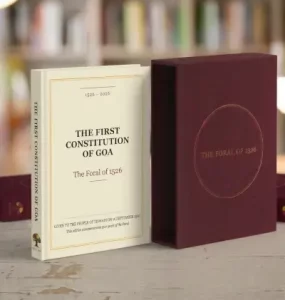
The commemorative edition marks 500 years since the charter was concluded on September 16, 1526. Following negotiations between Portuguese officials and 31 village chiefs from Tiswadi, Goa, the document recorded 47 provisions concerning land, cultivation, taxation, inheritance, justice, and village administration.
For Menezes, these provisions reveal how local communities participated in shaping the arrangements under which they were governed. The Foral recognized existing customs and institutions, documenting the accommodations through which Portuguese authority operated.
“It is that Portuguese power could not simply dispense with Goan institutions, customs, property arrangements, and people. The Foral records the accommodations that resulted,” Menezes said.
The book’s title invites readers to consider what a constitution meant in this historical setting. Menezes approaches the Foral both as a written charter and as an agreement that helped constitute a society’s relationship with government. This interpretation places the agency of Goan communities at the center of the document’s political significance.
Its influence also extended across generations. The Foral was invoked and contested in disputes over land, a daughter’s right to inherit, and efforts to preserve Goa’s comunidades, institutions through which communities administered land, agrarian, and village affairs. Tracing these debates, the commentary examines how successive generations returned to the charter to make claims about rights and authority.
Bringing the document to contemporary readers required careful interpretation of language written five centuries ago. Menezes and Lourenço drew on their archival knowledge and historical training to produce the translation, using footnotes to clarify technical terminology and questions of meaning.
The publication builds on Menezes’s research into early modern South Asia and the Indian Ocean world, with a particular focus on Goa and the Iberian presence in Asia. His work explores how agrarian communities, labor, and commodities shaped empires, connecting local experiences with wider histories of commerce and political authority. He holds a Ph.D. in History from Georgetown University, Washington D.C.
Issued as a collector’s edition limited to 500 copies, the volume opens the Foral to a new readership. For Menezes, its anniversary is also an opportunity to encourage further study of Goa’s past.
“I hope that a new generation in Goa will feel motivated to devote themselves to the study of history,” he said.