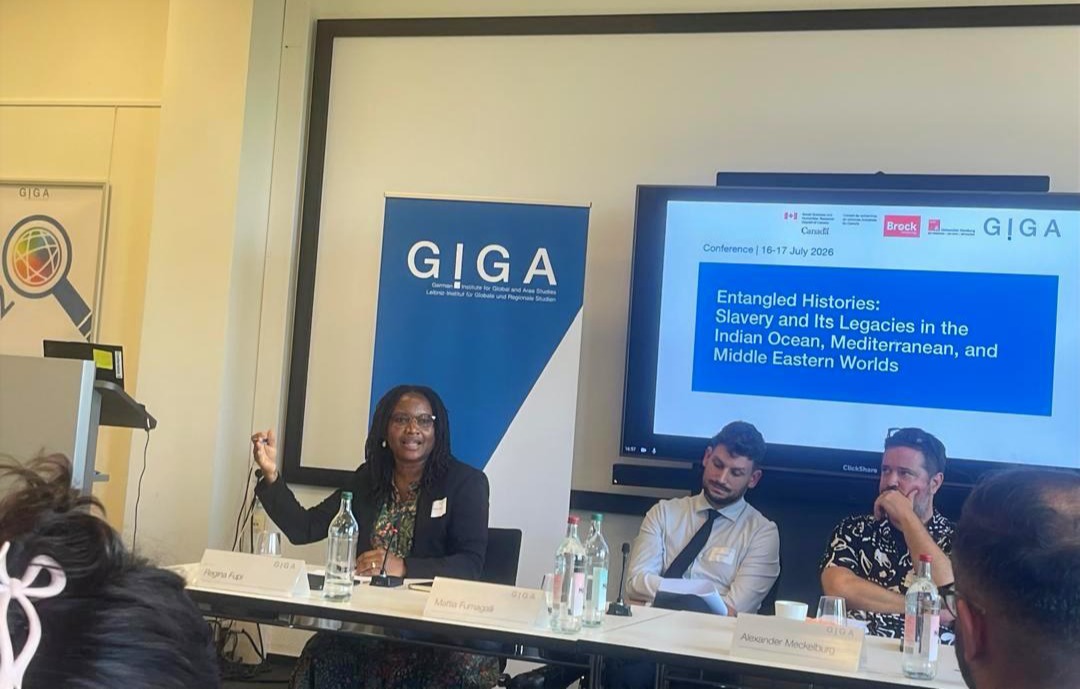
Regina Minael Fupi, Lecturer of Kiswahili at The Africa Institute, Global Studies University, presented research examining how Kiswahili carries histories and memories engendered by slavery, migration, and cultural exchange across the Indian Ocean world.
Her paper, “Kiswahili as a Living Archive of Entangled Histories: Language, Memory, and the Legacies of Slavery in the Indian Ocean World,” was presented at Entangled Histories: Slavery and Its Legacies in the Indian Ocean, Mediterranean, and Middle Eastern Worlds, held on July 16–17, 2026, in Hamburg, Germany.
By approaching Kiswahili as a living archive, Fupi’s research highlights how language can preserve cultural memory and lived experience beyond conventional written historical records.
The multidisciplinary conference brought together scholars and policymakers to examine the economic, political, and cultural relationships connecting communities across the Indian Ocean, Mediterranean, and Middle Eastern worlds, particularly in relation to slavery, forced migration, and their continuing legacies.
Hosted by the German Institute for Global and Area Studies (GIGA) and the University of Hamburg, in collaboration with Brock University in Canada, the conference adopted an approach aligned with UNESCO’s Slave Route Project, which examines the global impact and continuing significance of the forced migration of enslaved people.
Fupi’s research reflects GSU’s interdisciplinary approach to African languages, recognizing them not only as forms of communication but also as important sources of historical and cultural knowledge.