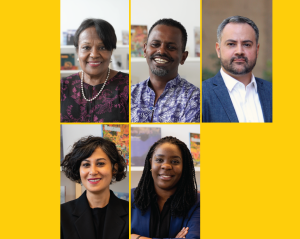
The visibility of Black women in narratives of resistance and the place of ancient Egypt in contemporary cultural identity were the focus of two lectures that opened The Africa Institute, Global Studies University’s (GSU) Fall 2026 Senior and Postdoctoral Lecture Series on September 10, 2026.
Held in the GSU Auditorium, the session drew 45 attendees, including faculty, fellows in residence, MA and Ph.D. students, and members of the wider community. It featured Gladys Kalichini and Reem Kosba, the 2026 recipients of the Okwui Enwezor and Fatema Mernissi Postdoctoral Fellowships, respectively. Their presentations examined how visual and material culture influence whose histories are recognized and how the past is interpreted in the present.
Kalichini, Okwui Enwezor Postdoctoral Fellow in Visual Culture, Performance Studies, and Critical Humanities, explored portrayals of Black women in Kudzanai Chiurai’s trilogy Revelation (2017), Genesis [Je n’is isi] (2016), and We Live in Silence (2017).
Her lecture, “Beyond the Patriarchal Frame,” approached visibility as a shifting condition shaped by power. Through close readings of Chiurai’s imagery and historical references, she examined how Black female figures move between symbolic representation and expressions of individual agency within narratives of resistance and national remembrance.
Kalichini argued that the trilogy opens possibilities for more inclusive interpretations of history while exposing the difficulties of securing sustained recognition of Black women’s political and historical roles. The research builds on her study of women’s visibility and erasure in anti-colonial and liberation struggles.
Maha Bashri, Director of Research and Programming and Associate Professor of Media and Communication at The Africa Institute, GSU, moderated the session.
Kosba, Fatema Mernissi Postdoctoral Fellow in Social and Cultural Studies, examined the contemporary resurgence of ancient Egyptian imagery and heritage in her lecture, “Neo-Pharaonism and the Contemporary Representation of Ancient Egypt in Egyptian Material Culture.”
Her presentation explored how Egyptians reinterpret and adapt ancient heritage amid the continuing social, political, and economic effects of the Arab Spring. Drawing on material culture and reception studies, she considered how cultural practices and public spectacles draw on the past to shape ideas of identity, creativity, and national belonging.
Kosba situated these developments within the longer history of Pharaonism, which placed ancient Egypt at the center of early twentieth-century debates about modern Egyptian identity. She also traced how colonial collecting practices and Eurocentric scholarship continue to influence representations of Egyptian antiquity, raising questions about ownership, repatriation, and cultural authority.
The lecture reflected Kosba’s broader research across religion, feminist studies, and material culture. Sabrina Moura, Associate Professor of History of Art and Visual Studies at The Africa Institute, GSU, moderated the session.